Account visibility on X
Twitter Shadowban: How to Check If You're Affected
A reply stuck at three views is easy to dismiss. When the next several replies barely move either, while your own posts still reach people, it starts to feel as though something has changed. Your account isn't suspended. You can still post. From your side, everything looks normal.
This is one of the situations people describe as a Twitter shadowban, or an X shadowban. The term covers several different problems: replies getting buried, posts missing from search, or a restriction that affects distribution without stopping you from publishing.
The distinction matters because the response depends on what is happening. An explicit account label gives you something to review or appeal. A reply placed low in a busy thread tells you much less. Before deleting posts or taking a week off, it's worth finding out where the visibility changed.
Low reply reach deserves a closer look
Compare your replies with other replies you've written, rather than comparing them with your original posts. They have different opportunities to be seen. A post can reach your followers directly; a reply has to find an audience within a particular conversation.
Even the size of the parent account can be misleading. A huge account may attract thousands of replies, and yours can be difficult to find among them. Replying after the discussion has moved on gives you a different opportunity from joining while people are still reading and responding.
X also doesn't show every reader the same reply order. Its conversation-ranking documentation names factors including whether the reader follows you, whether the original author replied, and Premium status. Finding your reply near the bottom from another account doesn't, by itself, identify an account restriction.
A repeated change across otherwise similar conversations is more worth investigating. For example, your recent replies consistently stall while older replies on comparable topics used to attract readers. That is a reason to check visibility, particularly if the change coincides with a notice from X. It still doesn't tell you the cause on its own.
There is no useful universal cutoff such as “under 10 views means shadowbanned.” X counts the author's own views, and views aren't all unique people. Reopening a reply while testing it can add to the number. Crossing 10 views therefore cannot certify that a restriction has lifted either.
How to check for a Twitter shadowban
Use a few existing posts to investigate, including both replies and original posts. You want to understand a pattern without filling your account with “can anyone see this?” messages.
A signed-in account that doesn't follow you is a useful second viewpoint. A trusted person can check from theirs. Ask them to look rather than like or repost: coordinated engagement would change the observation you're trying to make. A logged-out browser is a weaker comparison because X may limit what it lets that visitor see.
Start with the direct link to a reply, then open the parent conversation separately. A reply that loads from its own URL but is difficult to find in the thread is still accessible. Its placement is the question. Look for any additional-replies or spam section, and distinguish that from the original author deliberately hiding it.
That last possibility is easy to overlook. Post authors can hide replies, and X says the reply's author isn't notified when they do. One hidden reply in one person's conversation is not evidence that your replies are being hidden everywhere.
Then check search with something simple:
from:yourhandle "a distinctive phrase from your post"Replace the handle and phrase with your own. Use Latest, and leave out engagement, language and media filters for this check. If you're working with an older post, the Twitter Advanced Search operator reference explains how to add a date range without accidentally excluding the day you need.
Search results need context too. Protected posts, sensitive-content settings and the searching account's muted or blocked accounts can affect visibility. X also says not every post appears in search. A missing result becomes more informative when several known public posts fail the same check, after you have accounted for those settings.
Keep a small record of the URLs, date, checking account and what was visible. “This reply loads directly but is absent from this thread view” is much more useful evidence than “my account feels dead.” It gives you something you can repeat later or include in a support request.
What a shadowban checker can actually tell you
A Twitter shadowban checker can save you some of that inspection, but its verdict depends on what it was able to observe. Some tools check search and username suggestions; others also inspect reply threads. Those are different tests, even when the result screens use similar language.
| Label you may see | What it usually describes |
|---|---|
| Search suggestion ban | The handle wasn't found in the tool's autocomplete or suggestion check. That is narrower than checking whether posts appear in search. |
| Search ban | The tool couldn't find expected posts in its search results. Check the query and account settings before treating it as a diagnosis. |
| Ghost ban | The tool couldn't find a reply in the conversation it inspected, even though the reply may still open directly. |
| Reply deboosting | A reply appeared in a lower-visibility or additional-replies section. It describes an observed placement, not necessarily the whole account. |
These are common checker labels, not four official diagnoses with standardized tests. A useful result should tell you which post or search was checked and whether the check actually completed.
For example, SocialCal's published methodology describes search and conversation checks, cached results, and an unknown result when rate limits prevent a check. That explains why refreshing a checker repeatedly may not give you new evidence. Its published reliability figures are the provider's own claims, not an independent accuracy guarantee.
If two tools disagree, compare the observations behind the labels. One may have inspected an older reply, or been unable to load a conversation. An incomplete test should stay inconclusive. It should not become either a ban or an all-clear simply because the page needs a colored result.
A clean result has limits as well. It can show that the tested posts were discoverable at that time. It can't establish how widely future replies will be recommended, or rule out every kind of restriction.
An explicit temporary label is stronger evidence
A notification from X saying that a temporary label may affect your account's reach changes the situation. You now have a stated restriction to investigate, rather than an inference from low view counts.
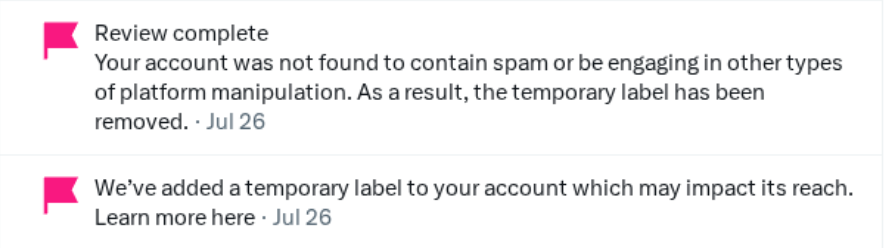
Open the notice and read the reason. If it offers a Request Review option and you believe the restriction is mistaken, use it. Keep the notice and the relevant post links so you can explain the issue precisely.
X separately documents visibility limits on individual posts, including exclusion from search and lower placement in replies. It says authors can appeal a visibility label when they believe the action was wrong. An individual post label and an account-level notice are not interchangeable, so follow the route attached to your particular notice.
If the account is locked or certain actions are disabled, follow the locked or limited account instructions. X may require an ownership check or another action before a timed restriction begins counting down. Waiting without completing that step may not resolve it.
For an explicit suspension notice, see what to do about a suspended Twitter account, including the evidence to preserve and how to explain a disputed decision in an appeal.
Don't assume that every review finishes within a day. If a label is removed, that confirms the label was removed; it doesn't promise that the next reply will reach a particular number of people. With no notice, keep your observations specific rather than trying to appeal a checker label as though X issued it.
What to change when your replies keep getting buried
Review a run of your recent replies together. A single mention of your product can look perfectly reasonable. The same mention underneath a dozen unrelated posts tells a different story.
X's authenticity policy explicitly covers bulk unsolicited replies, irrelevant promotion, repetitive content and repeated links without commentary. Those are useful things to inspect because they are documented behaviors, rather than guesses about a secret score.
Pause a repetitive or high-volume reply routine while you review it. That includes replies written by hand. The way a message was sent doesn't make an irrelevant pitch useful to the person receiving it.
Look at what each reply contributes to its specific conversation. Could you paste it beneath ten other posts without changing anything? Does it answer the question, or mostly lead to your product? Are you repeatedly joining arguments with insults? This review is more actionable than trying to infer how many reports an account might have received.
Remove content you decide is spam or abusive, and follow any specific removal requirement from X. But don't mass-delete legitimate posts just because they contain links or have low views. A useful source link isn't the same as repeatedly dropping an advertisement, and deleting everything also removes the examples you were trying to compare.
When you return to replying, choose conversations where you have something specific to add and keep the volume manageable enough to read them properly. There is no published universal safe allowance of replies per hour that guarantees unrestricted reach.
How long does a Twitter shadowban last?
The difficulty with this question is that “shadowban” can refer to any of the situations above. A timed account restriction, a label under review and a reply that simply ranked poorly do not share one recovery clock.
You will see advice to stop replying for 48 hours, 72 hours or seven days. If your recent activity was repetitive, a week away from that routine can be a sensible period to review it and compare what happens afterward. Treat the week as a review schedule, though. It is not a documented timer that clears every visibility problem.
If the account remains unrestricted for posting, you can continue sharing original posts you would normally publish. There is no need to manufacture activity to look human, or to post a quota of original tweets in the hope of resetting an account score.
After the break, make a relevant reply in an active conversation and repeat the visibility checks from the same outside viewpoint. Consider more than one example over time. A reply receiving 11 views after another received three is too little evidence to declare recovery, especially when the conversations have different audiences.
If the issue persists, return to the account notices and the exact pattern you recorded. Search-only problems deserve different investigation from replies repeatedly placed behind a spam section. Waiting another week without checking what changed can leave you repeating the same experiment without learning anything.
Be careful with advice about fixing your reputation score
Reputation isn't an invented concept. Twitter's published algorithm code includes a reputation calculation based on PageRank. But a public implementation is not a live reading of your account, or proof that all current visibility decisions come from one score.
That gap matters when someone offers precise rules: keep your following count below half your followers, obtain a like from a large account, or accumulate enough positive interactions to cancel a report. Those claims would require evidence about the current system and your account. A checker showing missing search results doesn't provide that evidence.
Genuine interaction with people in your field is still useful. So are original posts and replies that people choose to respond to. The benefit doesn't require pretending that one prominent person's like transfers a known amount of reputation to you.
Buying engagement or mass-unfollowing people to hit a ratio is a particularly poor response to suspected spam filtering. X's authenticity rules also cover engagement manipulation and aggressive follow churn. Completing a phone or email challenge that X actually requests is different from treating verification as a reach-repair shortcut.
The clearest signs of improvement are observable ones: a notice has been resolved, posts that were missing become discoverable, and replies can be found across several conversations. Keep those observations separate from how popular each post becomes. That gives you a much firmer basis for deciding what to do next than a single view count or a checker's red badge.